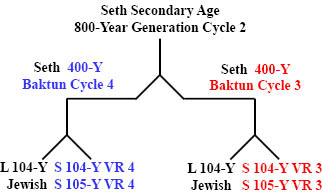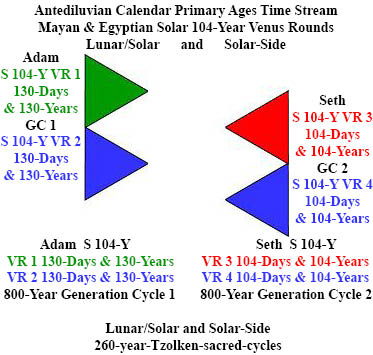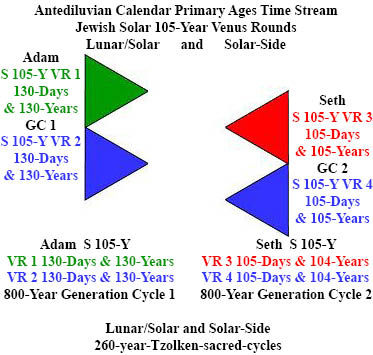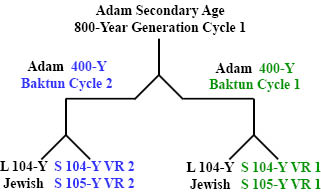
The secondary age category entails thirteen 400-year-Baktun-cycles
in the vernacular of the Mayan calendar. The end of Adam’s second
400-year-Baktun-cycle completes the first 800-year Generation Cycle
in the secondary age category. The Antediluvian Calendar
system applies 13 steps of 400-year-Baktun-cycles to describe the
5200-year Great Cycle from Adam to Enoch.
HoH
Secondary 800-Year Age of Adam
The secondary age category entails thirteen 400-year-Baktun-cycles
in the vernacular of the Mayan calendar. Each
400-year-Baktun-cycle is the halfway, midpoint position for the
entire Patriarch’s 800-year Generation Cycle. The end of
Adam’s first 400-year-Baktun-cycle in the secondary age category
also identifies the end of 130-years in the primary age
category. The end of Adam’s second 400-year-Baktun-cycle
completes the first 800-year Generation Cycle in the secondary age
category.
Seth’s secondary 807-year age follows the same pattern. The
third 400-year-Baktun-cycle in the lineage is also Seth’s first
400-year-Baktun-cycle for the secondary age category. Again,
at the halfway point, Seth’s 105-year primary age of solar-side time
split ends simultaneously with Seth’s first
400-year-Baktun-cycle. The fourth 400-year-Baktun-cycle adds
to the secondary age category for Seth. Seth’s secondary age
800-year Generation Cycle finishes at the end of the fourth
400-year-Baktun-cycle. A final period lasting 7-sacred-years,
or about 1,820-days, adds the last primary age 5-years according to
the Enochian 364-day calendar year. The 365-day-solar-year
adjusts to add approximately 7-sacred-years from the last 5-years in
Seth’s 105-year primary age.
The Great Cycle is a variation of the Long Count Initial
Series. Formerly developed in conjunction with the Dresden
Codex, the Long Count begins with the presumed Mayan Creation date,
noted as 13.0.0.0.0. The most significant digits on the left
are Baktuns (400-years), next are Katuns (20-years), and Tuns
(360-days), and Uinals (20-days), and Kins (days). The Long
Count measures from 13 Baktuns, or 5200-Tun-years. Therefore,
conjecture rationalizes at least 12 Baktuns and possibly 13 Baktuns
to have elapsed prior to the onset of the Long Count. The
Great Cycle, on the other hand, introduces a cyclic calendar system
whereby 5200-Tun-years repeat to mirror the 52-year Calendar
Round. The secondary age category cumulatively adds to achieve
the 5200-Tun-year, or as some historians agree, 5200-Haab-years in a
Mayan Great Cycle. The Great Cycle is generally associated
with 5200-Tun-years having 360-days each. Depending on the
context used, some opinions favor the 365-day-Haab-year. The
special treatment of the Wayeb 5-feast days between the
360-day-Tun-year and the 365-day-solar-year is usually included in
Long Count projections.
The Antediluvian calendar system applies 13 steps of
400-year-Baktun-cycles to describe the 5200-year Great Cycle from
Adam to Enoch. Six 800-year Generation Cycles extend the
secondary age category to represent the lives of six
Patriarchs. The six secondary ages measure time since
fatherhood until the character’s death. Adam, Seth, Enos,
Cainan, Mahalaleel and Jared each increment the secondary age
category total by two 400-year-Baktun-cycles each. Extra time
beyond the 800-year Generation Cycle expresses in terms of
260-day-sacred-years in the first example, Seth. The secondary
age of Adam is the 800-year Generation Cycle in Genesis 5:4. The secondary
807-year age of Seth includes the 800-year Generation Cycle, plus
7-sacred-years (Genesis 5:7).
The Holy Bible commits the
bulk of this Holy_of_Holies
to exploring given ages for the Antediluvian Patriarchs from Enos to
Enoch. Ages_of_Adam
harvested calendar information from several known sources. The
Jewish Calendar, Egyptian Calendar and Sun Kingdoms’ Calendars of
the Americas assist to discern fundamental requisites of lunar/solar
calendar operations. Enhancing our view of ancient time
recording, additional materials from the Book of Jubilees, the Dead
Sea Scrolls, the Book(s) of Enoch and mythological inferences
compile for better awareness about ancient calendar systems.
Styles of writing and the consistency of meanings are useful in
dating ancient texts. The purpose here is to extract pertinent
fragmentary evidence offered by ancient writings to facilitate
reconstruction of the oldest calendar system.
Supplementary literature serves our calendar interests.
Original Septuagint texts translate to compose most of the canonical
Holy Bible. The
Septuagint is aptly noted LXX, for the legendary seventy or so
scholars involved. Ptolemy II (285–247 B.C.E.) requested six
translators from each of the twelve tribes of Israel to work at the
library at Alexandria. They translated the first five books of
Moses, or the Torah.
The Pentateuch means is the same name in Greek. Most scholars
estimate the latter part of the third century for scripture
translations into Greek. We are far more interested in the
information disseminated in the text rather than every jot, yod or
tittle (Matthew 5:18).
In English, this compares to crossing the t’s and dotting the
i’s. We can rest assured diligent care was exercised by
Septuagint translators in creating Greek rendition(s) of the Bible. According to the
Letter of Aristeas, the Jerusalem high priest, Eleazar, was to
appoint trained Jewish sages to generate precise translations.
Noteworthy resources embrace various stages of correspondence with
several collections attributed to be authentically Septuagint.
A survey of the similarities and differences yields more specific
calendar information targeted toward resolving the ages listed in chapter 5 of Genesis.
Contributing texts are placed against the background of accepted
calendar systems. Several Apocryphal (false writings and not
canonical) also came to light between 100 B.C.E. and 300 A.D.
Striking 100-year differences exists between the Antediluvian
Septuagint calendar ages and those respective ages in the
traditional Bible. A
contrasting first 100-years of difference exists between the primary
age of Adam, as reputed by the Septuagint, and the accepted 130-year
age in the later Holy Bible
versions. The Septuagint mentions the primary age of Adam to
be 230-years at Seth’s birth in Genesis
5:3. The Septuagint’s primary 230-year age of Adam
departs from a wider set of l/s calendar terms, which indicate
Septuagint translators were working with a discrete 100-years
term. This 100-year difference leads us to distinguish
100-years stood alone in the script.
This illustration suggests that 100-years are an isolated
term. Associated numerical matching of X-days with X-years
bolsters a more comprehensive scheme that situates the difference
between the 260-year-sacred-cycle and the 360-year midpoint type of
cycle. Mayan calendar terminology substitutes for the
equivalent 260-year-Tzolken-cycle and the 360-year-Tun-cycle.
Important considerations that select 100-days-and-years graphically
determine the difference between 260-day-Tzolken-years and
360-day-Tun-years to formulate the larger frames of
260-year-Tzolken-cycles and 360-year-Tun-cycles. A distinct
100-year term is visible in multiple translated texts.
Emphasis for the primary age measures from the characters’ beginning
to the primary age time at fatherhood. In the popular Holy Bible, Seth’s primary
105-year age revises to be 205-years in the Septuagint.
Scrutiny of the Holy Bible
primary 105-year age of Seth reinforces the notion that the 100-year
portion was likely a 100-days-and-years single term and 5-years
shared the very same treatment by referring to a special
5-days-and-years single term. Ending the 360-day-Tun-year with
the special 5-day Wayeb period agrees with ending a
360-year-Tun-cycle with an outstanding terminal 5-year Wayab.
Seth’s last 5-years in the primary age, or 1,820-days, link with
7-sacred-years in the secondary age (Eqn. 13).
One must revert to the older versions, as translated from Torah, to give proper credit to
the Holy Bible. Our
modern English versions of the Holy
Bible better preserve original settings cast by the Torah. The Greek
Septuagint did a more accurate job of translating spiritual
underpinnings as opposed to precise numbers. Modern word
searches and the capabilities of the Internet enable exhaustive
searching.
The secondary 800-year age of Adam, measured from fatherhood until
Adam’s death, also mutates regarding 700-years in the
Septuagint. The primary and secondary ages of Adam are offset
by 100-years according to the Septuagint. The identical
100-year deviation between the sacred texts affects the secondary
age of later characters in the secondary age category by the same
amount. The mainstream of the Septuagint copies the
generational flow from the character’s age at fatherhood until the
characters death. Mesoamerican l/s calendar ages were ideally
fixed for both 130-years as half of the 260-year-sacred-cycle, and
the 400-year-Baktun-cycle as half of the larger 800-year Generation
Cycle.
The original Hebrew texts maintained accuracy in keeping with the
Sun Kingdom’s calendars. Specific calendar units of
measurement show the principal time reckoning ingredients embedded
as bits and pieces. Differences lasting 100-years continue
throughout the remaining Septuagint genealogy. Seth, for
example, has 205-years in the primary age category at his fatherhood
of Enos. The secondary 707-year age for Seth likewise
indicates a 100-year shortfall from the Holy Bible account. Both cases for Adam and
Seth eventually sum for the total age life spans of 930-years for
Adam and 912-years for Seth, respectively.
Septuagint translators had access to Torah scrolls and other manuscripts that modern
people may never know. Fire partially destroyed the library at
Alexandria when Julius Caesar laid siege to the city in 48
B.C.E. The Septuagint was the first canon in the Greek before
the New Testament.
Books and parts of books were included in the canon. Greek
editions of the Hebrew Bible
in many different languages aided the spread of Christianity.
Some early churches rejected Apocryphal and related works.
Septuagint research through all stages, amplifications and
modifications is a separate study. Every language and even
dialect has particular meanings and interpretations akin to
itself. New translations and revisions are undergoing
development to this day.
Stringent rules for recopying Torah
scrolls have always been in effect. Asserted in Deuteronomy 4:2 and 31:24-26,
divine instructions must preserve all scriptures intact. Words
or meanings cannot be added or removed. Stewardship of the
scriptures was granted to the Levite priesthood. The New Testament later affirms the
“oracles of God” are
committed to the Jewish people (Romans
3:2).
The earliest scriptures designed to protect the sanctity and
original meanings inherent to the Hebrew Bible determine the copy practices of the Levite
priesthood. The chosen Levites were to make new copies of the
Bible as older copies wore
out. Meticulous rules were developed for transcribing
text. Every page needs to be an exact duplicate, word for
word, and letter by letter. Counting numbers of words and/or
letters per page permitted comparisons to the original text.
Up to three people eventually were required to make a copy. A
copyist sat in full Jewish dress, accompanied by at least two others
tasked with checking the manuscript for errors. Safeguarding
the Sacred Text enabled the acclaimed “fence to the
scriptures.” Words and letters remained locked into
position. A single mistake caused the entire work to be
destroyed and the whole process to be started over.
The Temple Scriptures rested inside the Ark of the Covenant of the Holy of Holies. The
increasing Jewish population used the same methods for worship and
observance wherever they settled. Levite scribes continued to
painstakingly duplicate and distribute copies. The Masoretic
text of the 9th century C.E. seems to be a standard of authenticity
for Biblical scholars. Observing technical terminology and
relevant style helps to date scrolls and other written
information. The last Old
Testament Prophet and scribe, Ezra is said to have fixed
the canon of the Old Testament
about 400 B.C.E. Masoretic text also refers to later versions
that date between 500 - 1000 C.E. The moral to this condensed
story is to realize due precautions have been observed to ensure the
highest degree of content and meaning are conveyed by the new
copy. The early pathways of the Holy Bible tell the story of Judaism and the
calendar practices of ancient civilization.
Examination of the 100-years precludes simple editorial corruption
concerning the frequency and deliberate variations of the
Antediluvian ages. The 100-day-and-year single terms begins to
take new meaning by the separating “two” component from the
50-year-Jubilee-cycle(s) of Leviticus.
Periods of 7-weeks having 50-days are celebrated by the Jewish
Calendar festivals of Passover and the Counting the Omer that leads
to Shav’ot. The King James Version (KJV), New International
Version (NIV) and many other versions have corrected any Septuagint
errors to reflect the original Hebrew.
The Hebrew alphabet is a language and numbering system.
Translating numbers into Latin, Greek and finally English combines
the numerical value and the unit. Two passes of the
50-day-and-years single term, rather than 100-years, substantially
alters our interpretation of the Antediluvian ages. Original
Hebrew documents such as The Book of Jubilees and the Book(s) of
Enoch counted the number of repetitions of time cycles or addressed
specific days and months during the year. Counting Jubilees as
either 49-years or 50-years has been a point of controversy in
scholarly circles. Seven-day weeks and 7-year-Sabbath-cycles
involve the lunar-side of l/s calendars. Many works mention a
decree proclaiming heavenly tablets held written calendar
information.
The Book of Jubilees, or the Book of Divisions, is another sacred
historical text earlier introduced in Ages_of_Adam. Most likely written in the 2nd
century B.C.E., the Book of Jubilees is a historical account from
Creation to Moses. The narrative divides Jubilee periods into
49-years in a familiar story comparable to Genesis. The only
complete version of the Book of Jubilees is in Ethiopic. Large
sections survive in Latin and Greek.
Are you a pastor, educator or a student of the Holy Bible? Timeemits.com
seeks anointed people to review and contribute to the Ages_of_Adam ministry.
Ancient lunar/solar calendars like the Jewish and Mayan calendars
provide the background to understanding early time. Ancient
calendars of the Holy Bible
use differences between the moon and sun, numerical matching and a
364-day calendar year to describe X-number of days that match with
X-number of years. Ages_of_Adam
is a free read at timeemits.
Clark Nelson is webmaster for http://www.timeemits.com/Get_More_Time.htm,
author of Ages_of_Adam and
sequel, Holy_of_Holies.
Copyright 2006 Clark Nelson and timeemits.com All Rights
Reserved. URL http://www.timeemits.com/HoH_Articles/HoH_Secondary_800-Year_Age_of_Adam.htm
Secondary, age, category, Patriarch, Generation, Hebrew, Jubilees,
Enoch, tablets, Septuagint, Torah, Passover, Latin, Greek,
Leviticus, scroll